
“Natural Organic Reduction.” That’s the marketing name for human composting, and Maryland families are seeing it everywhere right now, on brochures, on commercials, in newspaper spreads. The name does a lot of work. It sounds like something the earth already does on its own, gentle and inevitable. Whether it earns that word is the question this piece answers. Dr. Howard Berg has spent the majority of his life in Maryland and more than 35 years as a surgeon. He is now as the co-founder of Serenity Ridge, the state’s first 100% natural burial cemetery. He built the following comparison the same way he once built a diagnosis, plainly, with the facts laid out before anyone is asked to decide anything. So, before you decide what “natural” means for your family, we invite you to read our assessment and comparison to help you understand what the name is describing.
What Human Composting Involves
Human composting breaks a body down into soil-like material over 30 to 60 days, inside a temperature-controlled vessel. That process needs more than time to work.
The Industrial Process Behind the Name
Over the full 30 to 60 day process, a human composting facility requires:
- Continuous electricity to power the vessel and ventilation systems
- Continuous water to maintain proper moisture levels throughout decomposition
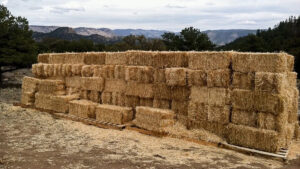
- A steady supply of organic bulking materials—such as wood chips, straw, or alfalfa—harvested elsewhere and added to every vessel
- Ongoing monitoring of temperature, oxygen levels, and airflow by trained staff
- State regulatory oversight similar to that required for other licensed industrial processing facilities
A body does not require any of these inputs to return naturally to the earth. A human composting facility does.
At the end of the process, approximately 1 to 1.5 cubic yards of material remain—roughly 300 to 500 pounds, or enough to fill about half the bed of a standard pickup truck. Mixed within that material are approximately 10 to 15 pounds of processed, pulverized bone fragments, which are rich in calcium phosphate and highly alkaline. Because this material has a pH of approximately 11.8 and contains mineral concentrations that can exceed what many native plants can tolerate, several states regulate how and where it may be applied to the land.
For many families, this represents a fundamentally different outcome than traditional or natural burial. Rather than laying a loved one to rest in the ground, the family receives a large volume of processed organic material that must then be stored, distributed, or otherwise managed according to state law.
Why “Natural Organic Reduction” Misleads Families
The items above are what “Natural Organic Reduction” requires. Electricity, water, shipped-in bulking material, monitoring equipment, and state oversight aren’t what most families picture when they hear the word “natural,” while a natural burial asks almost nothing of the earth beyond the ground that’s already there. A body returns to soil through the same process it always has, with no machinery, no shipped-in material, and no facility built to manage it.
Serenity Ridge is certified by the Green Burial Council, the national organization that sets the standard for natural burial, and those standards were built around burial in the ground rather than around an industrial reduction process. The two methods simply aren’t being measured against the same definition of “natural” at all. If either one has earned that word, it’s the one that doesn’t require a warehouse.
How the Environmental Impact Compares to Natural Burial
That naming problem matters because it shapes how families weigh their options, and Serenity Ridge tracks the two methods across seven environmental factors, with natural burial carrying the lighter footprint on every one.
Energy, Carbon, and Infrastructure
A natural burial asks for a grave and a plot of protected land. Serenity Ridge itself sits inside an established nature preserve and arboretum, land already doing conservation work before it became a cemetery. Human composting asks for something different. It asks for a building, a supply chain, and weeks of managed operation before a single body has finished the process.
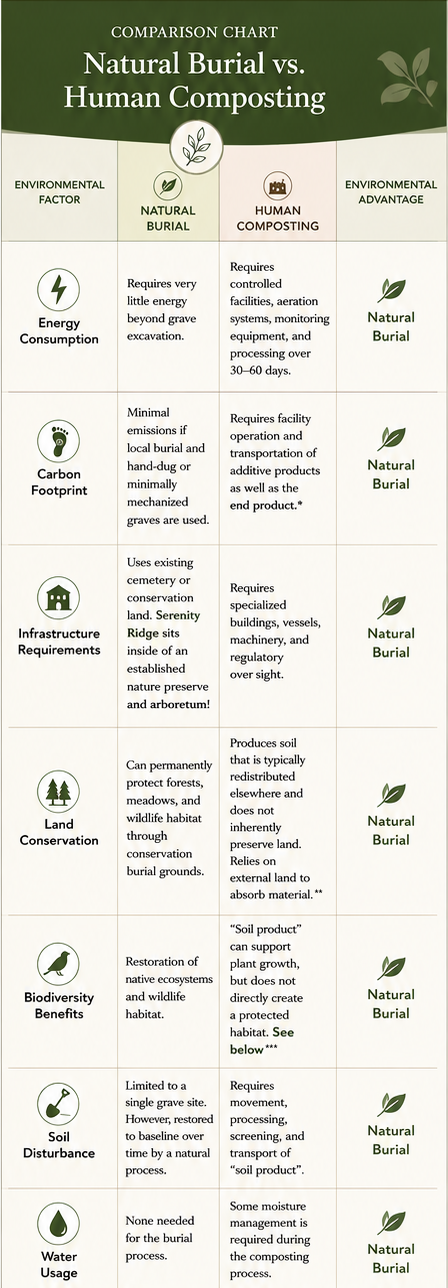
*Human Composting requires the use of large quantities of hay, straw, and wood chips to complete the “process”. These materials must be harvested, transported, and replaced continually. This creates an upstream environmental cost typically not discussed by the companies. Bottom Line: Human composting transforms the body, but the environmental footprint doesn’t disappear.
**Typical restrictions (vary by state). In Maryland, human compost soil is NOT allowed for food crop production, home gardens, sale, or commercial distribution.
***Excessive phosphorus, along with other chemicals, disrupts the natural nutrient balance of the soil and suppresses mycorrhizal fungi, which help trees and plants absorb essential nutrients. This encourages opportunistic invasive species to outcompete native vegetation. Native Maryland tree species, such as Oaks, Pines, and Hickories, are particularly sensitive to elevated phosphorus. In addition, nutrient runoff into nearby waterways can cause eutrophication, leading to harmful algal blooms, depleted oxygen levels, and fish declines.
Land Conservation and Biodiversity
Natural burial can permanently protect forests, meadows, and wildlife habitat through conservation burial grounds. It restores native ecosystems as part of the burial itself, so a grave becomes one more acre of protected land rather than a byproduct hauled somewhere else. Human composting produces a soil-like product that typically gets redistributed elsewhere. The process itself doesn’t preserve any land the way a conservation burial ground does. That product can support plant growth, but it doesn’t directly create protected habitat on its own.
Soil disturbance follows a similar pattern. A single natural burial grave is limited to that one site, and it settles back to baseline over time through an entirely natural process, while human composting requires its material to be moved, processed, screened, and transported before it goes anywhere at all, an upstream cost the marketing rarely mentions. Human composting transforms the body, but the environmental footprint that comes with it doesn’t disappear.
What Happens to the Soil After Human Composting
The finished material from human composting doesn’t work the way garden compost does, at least not under Maryland law.
Maryland’s Restrictions on Using the Finished Soil
Maryland law does not allow this material to be used for:
- Food crop production
- Home gardens
- Sale
- Commercial distribution
A family who chooses human composting expecting to plant a memorial tree or start a garden with the result may find that option isn’t legally available to them here. That’s worth asking about directly, because it’s a detail brochures tend to leave out.
The Risk of Elevated Phosphorus to Native Trees
The restriction exists for a reason. The finished material can carry elevated phosphorus and other compounds that create a soil nutrient imbalance. That imbalance can suppress the mycorrhizal fungi that carry nutrients to plants and trees. Native Maryland species, including oaks, pines, and hickories, are particularly sensitive to that kind of phosphorus load. An imbalance can open the door to invasive species at their expense. Runoff carries its own risk too, contributing to algal blooms and fish kills through eutrophication in nearby waterways.
Serenity Ridge sits inside an established nature preserve and arboretum, land set aside specifically to protect species like these. A threat to native trees isn’t an abstract concern here. It’s the reason the land exists.
Making an Informed Choice for Your Family
This comparison isn’t a sales pitch. It’s what Serenity Ridge’s own research turned up when the two methods were placed side by side. Dr. Berg wanted your family to have that same full picture, the way he once made sure his patients had it before surgery.
This might be a decision you’re planning for yourself, or one you’re facing right now for a parent, and either way, Serenity Ridge would rather walk through the specifics with you than leave you with a brochure. Wondering whether natural burial is the right fit for your family? Reach out to Serenity Ridge at 240-NATURAL, and someone will walk through it with you personally, without any pressure to decide before you’re ready.